


GALLERY MONTPHOTO 2026
Plant life
Place: PN Urbasa Andia, Navarra (Espanya)
Description:
We’d planned an autumn break for mid-autumn, hoping to find the woods at their most spectacular, but a few days beforehand there was a storm that blew away almost all the leaves, leaving just a few trees still in colour. So I wanted to capture in a single image that scene of dry leaves on the ground, along with some of the last yellow leaves on the beech trees. Double exposure in a single RAW file.
.jpg)
Paco Costa Cervera
Place: Bocsa (Hongria)
Description:
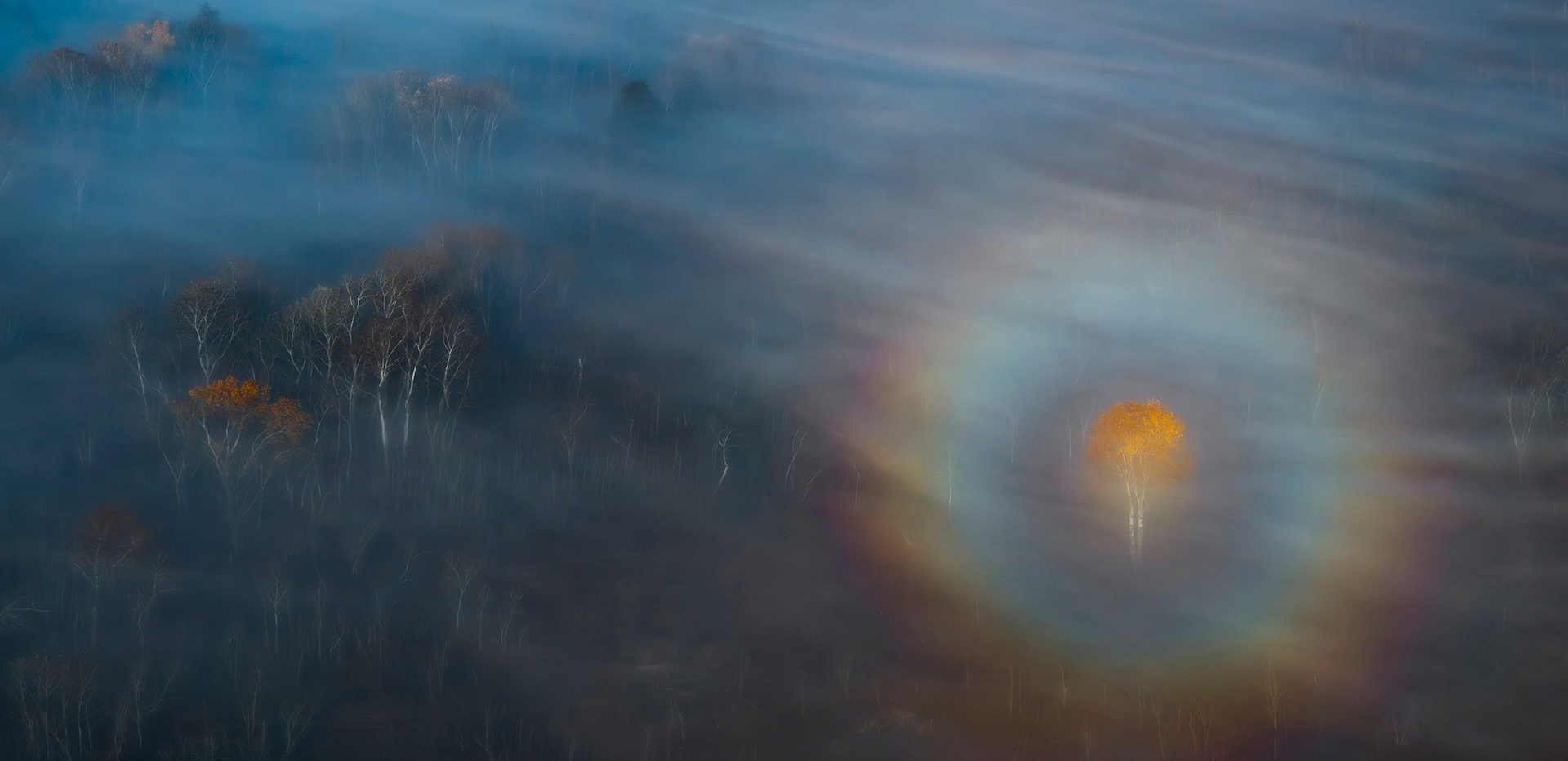
I've only seen this phenomenon from the window of an airplane. It's called Gloria. It occurs when the sun shines from behind us in foggy weather. I was flying over the landscape in a plane on this November morning when I noticed it. It was visible for half an hour. I took lots of pictures of it.
Csaba Daróczi
Place: Sandyston, New Jersey (EUA)
Description:
Flowers may bear markings that are visible only in the UV spectrum. While imperceptible to humans, these markings are visible to bees, serving to attract them from afar or guide their movement once on the flower. Using a long wave light, I found that portions of the pink lady's slipper flower (Cypripedium acaule), were differentially reflective of UV. Perhaps this serves to attract bee pollinators.
.jpg)
Ellen Woods
Place: PN Danubi Ipoly (Hongria)
Description:
I took this picture in the Duna-Ipoly National Park, near my hometown in Hungary. One of my favorite flowers is the pasque flower (Pulsatilla sp.), and its crop is also an interesting theme. I have photographed it many times and in many different ways. I used a long shutter speed, flash, flashlight and camera shake to create this picture.
.jpg)
Norbert Kaszás
Place: PN Danubi Ipoly (Hongria)
Description:
I took the picture of the maple seeds (Acer sp.). Perhaps there is someone who would not have played with these seeds as a child. I also used to have a a lot of fun with them and I wanted to turn this childhood experience into a picture.

Norbert Kaszás
Place: Xishuangbanna (Xina)
Description:
In a pond outside the tropical rainforest,these wild lotus leaves only leave a part of the veins of the lotus leaves (Nelumbo nucifera) , which looks like a scene that has already been destroyed. But the warm climate allowed heterosporous ferns (Saliviniaceae) to grow in the dilapidated lotus leaves. These ferns prefers to grow in warm and unpolluted waters. This is the rebirth of hope and a symbol of the continuation of life.
.jpg)
Yuan Minghui
Place: Massís Börzsöny (Hongria)
Description:
Lesser horseshoe bats (Rhinolophus hipposideros) overwintering in a mine passage sealed with a metal grate occasionally interrupt their hibernation, awaken and leave droppings. The two hundred bats, fragments measuring about half a centimetre can be seen, in places forming a continuous dark mass: bat guano. In the beam of the lamp, a whitish, fuzzy coating appears on its surface, a dung-dwelling species of pin mould fungus.
.jpg)
Imre Potyó






Rules of the web site | Legal advice | Privacy statement | Cookies policy | Change cookies preferences
Administration | Web design: ATMultimedia