


GALLERY MONTPHOTO 2026
Underwater world
Place: Golf de Califòrnia, Baixa Califòrnia Sud (Mèxic)
Description:
An olive ridley sea turtle (Lepidochelys olivacea) hatchling in the open ocean. It is exceptionally rare to see a hatchling in the expanse of the pelagic sea, so rare in fact that we call this period the 'lost years' of a turtle's existence.
.jpg)
Henley Spiers
Place: Illa Espíritu Santo, Baixa Califòrnia Sud (Mèxic)
Description:
California sea lion pup (Zalophus californianus) plays with a feather underwater. For a young sea lion, playfulness is a life strategy, building up the strength and agility needed to survive as adults. Mexico's sea lions are under threat by entanglement in fishing gear and the effects of climate change.
.jpg)
Henley Spiers
Place: Manado, Sulawesi (Indonèsia)
Description:
Encounter with a Taylor's inflator filefish (Brachaluteres taylori): A game of hide-and-seek between the arms of a see lily (Echinodermata Crinoidea). You can only spot this fish upon a closer look. This fish can also change color/patterns and blend in perfectly with their environment. Capturing this shot required a keen eye, plenty of patience (not to spook it), good buoyancy control, and, in this dive, efficient air consumption.
.jpg)
Michael Schreiber
Place: West Palm Beach, Florida (EUA)
Description:
This squid (Cephalopoda Teuthida) lays out a ink blob - not for escape, but rather is using it as a hunting veil to hide from its prey. It is theorized that this serves as more than just a visual blind, but also perhaps blocks chemoreception, and perhaps even dampens the way in which potential prey feel the squid's movements and vibrations. It stayed within the ink for ~15 minutes. Shot on a blackwater dive.
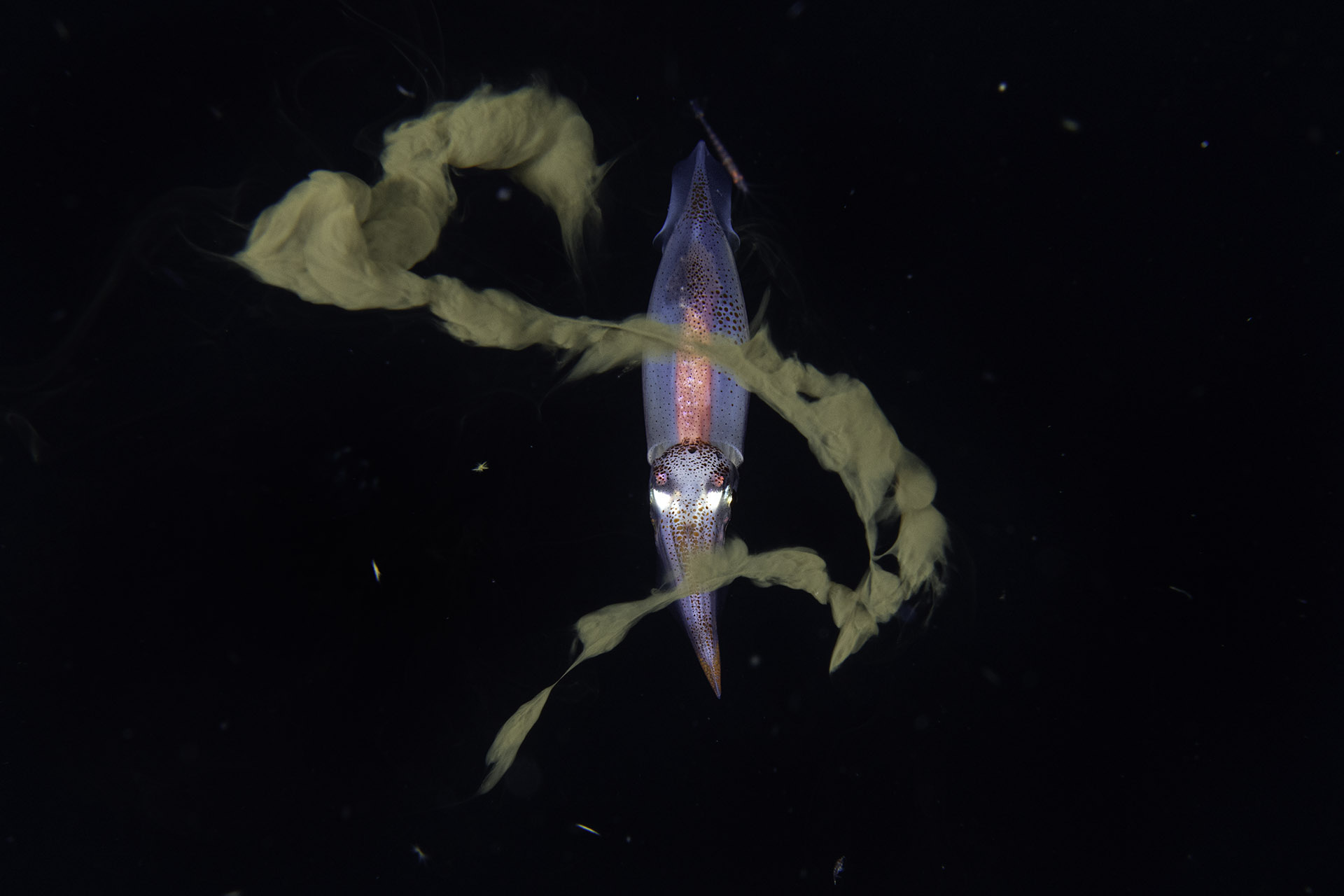
Chris Gug
Place: Illes Galápagos (Equador)
Description:
Despite their threatening appearance, marine iguanas (Amblyrhynchus cristatus) are a vegetarian species who allow an intimate approach by humans both above and below water. Here we see an individual foraging in turbulent water, I used a slow shutter effect to display the water movement.
.jpg)
Henley Spiers
Place: Tossa de Mar (Espanya)
Description:
Nests play a crucial role in the reproductive biology of grey wrasse (Symphodus cinereus). This species builds its nests on the seabed, usually in areas with sandy or gravelly ground, often very close to seagrass beds. The male attracts females to his nest and, after the eggs have been laid, takes responsibility for protecting and caring for them, keeping the nest in perfect condition.
.jpg)
Marc Casanovas Felix
Place: Cebu (Filipines)
Description:
Through the use of a slow-shutter technique and intentional camera movement, this spotfin lionfish (Pterois antennata) appears to glide through the water as movement transforms its fins into flowing shapes, revealing the subtle textures and patterns of the ocean in a single frame.
.jpg)
Jade Hoksbergen






Rules of the web site | Legal advice | Privacy statement | Cookies policy | Change cookies preferences
Administration | Web design: ATMultimedia